In the tribune The Tavern
Four Ideas for Democracy in Quebec

00 h 13 · 8 vues
A Democracy That Stops Selling Used Cars
In Quebec as in Canada, elections have become a genuine car dealership of promises. Party leaders stack commitments like salesmen pile options onto a car that's already blown past 200,000 km on the odometer. The difference? At your local garage, you leave with a three-month warranty. In politics, no warranty. Once elected, promises break down like the engine of the used car you just bought.
Man, oh man! Four years of payments for nothing. Pay up, you sucker.
The problem is that our electoral system allows politicians to promise anything during the campaign, then govern differently once in power, without real consequences. In reality, voters don't really listen and they forget. People have other things to do. We need to stop saying that "Quebecers" are politically engaged. It's false. "Quebecers" are just emotional people busy paying their taxes (or not paying them).
When the hollow promise "we're going to do politics differently" gives you a semi-crunch, that's maybe when you shouldn't vote.
If we want to restore value to voting, we need to impose a simple rule: fewer promises, more accountability.
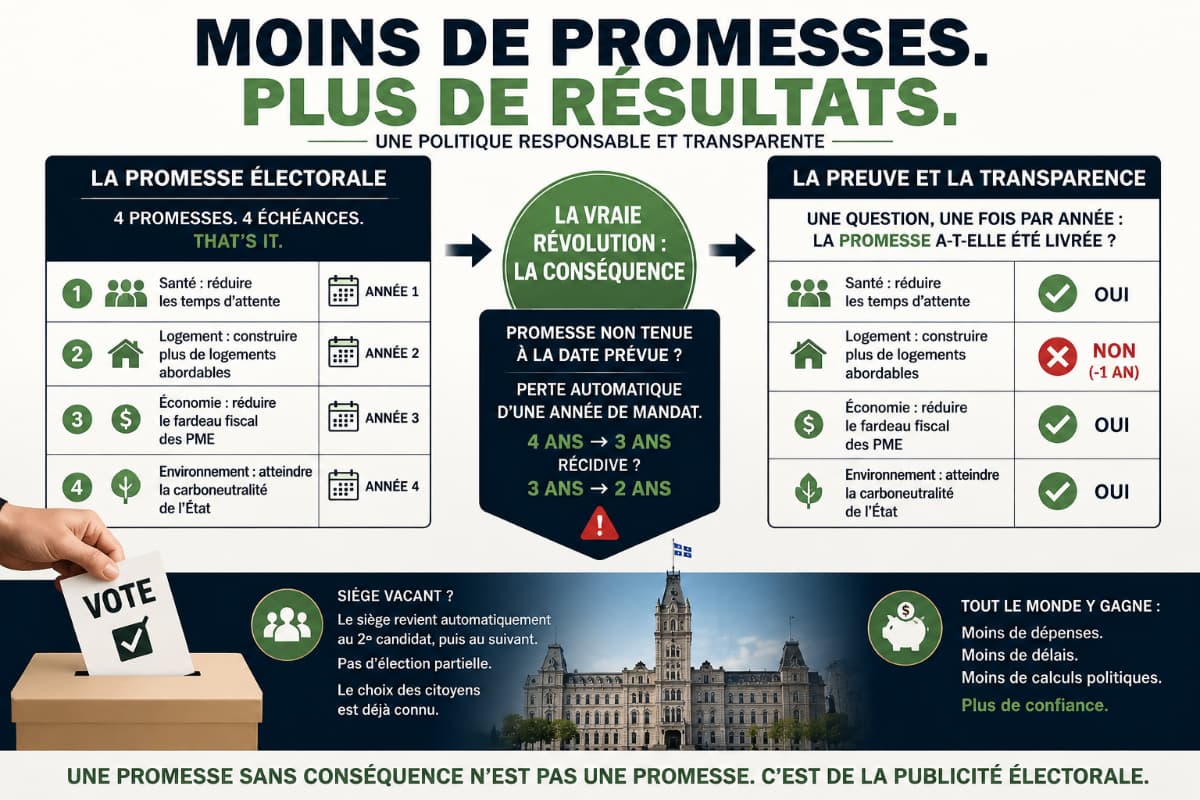
The idea might be new, or maybe not, but it seems more credible to me than some car salesman promising you anything. To get elected, each party could only write and promote four major promises in its election platform, one for each of the four years of the mandate. One priority to be realized in the first year on a specific date, one in the second, one in the third and one in the fourth. Everything else would remain orientations or proposals, but would no longer constitute election commitments.
During debates, party leaders could only debate their four major promises.
A Readable Contract for Voters
Such a model would force parties to choose which camp they're really in. No more hiding places. Are your promises far-left or reasonable-left? Opportunistic center or balanced center? Ideological right or pragmatic right?
Publicité
Today, platforms often look like catalogues with no clear priorities. We're selling hot air, because politicians' promises are worth nothing. Yet a voter should be able to understand in a few minutes what they're buying with their vote, what will be delivered, when in the mandate and in what order. Four promises. Four deadlines. A clear horizon. That's plenty enough to allow citizens to vote with knowledge of the facts and seriously judge a government, without drowning them in hundreds of vague or opportunistic commitments.
Most importantly, such a system would finally make governments accountable. At the end of each year, only one question should be asked: was the promise scheduled for that year delivered as promised, every dot and comma, yes or no? Bang! It's settled. You can't get more transparent than that. No need to wait four years to realize that half, and often the majority, of promises have been forgotten without anyone in the party batting an eye.
The rules would be known in advance, as would the deadlines. Citizens (and especially the media) would know exactly what to watch for and governments couldn't hide behind excuses or changing priorities based on polls.
Punish Failure, Not Image
The real revolution would be consequence (admit that sounds good). If a government doesn't deliver the promise scheduled for a given date, it automatically loses a year of its mandate. Four years becomes three. If it happens again, three becomes two. That's it, plain and simple. The government wouldn't gain the right to govern just because it was elected. It would also have to earn it by keeping its word.
Four promises. That's it.
With a rule like that, election campaigns would change completely. No more programs packed with impossible-to-deliver promises, impossible-to-measure promises or easy-to-postpone ones. Parties would be forced to choose their battles, to promise less, but to promise only what they're really capable of delivering within a specific timeframe.
End of By-elections
Same logic for vacant seats. If a member of parliament leaves during their mandate, no by-election. Thank you, goodbye. The seat automatically goes to the runner-up candidate. If they're no longer available, we move to the third-place candidate, and so on.
Why? Because voters have already spoken. No need to fire up the machine again, spend millions and start a mini-election circus every time a member decides to change jobs, retire or disappear from the political map. The citizens' choice is already known.
And let's be honest, some would think twice before leaving. Parties would too. They'd probably make sure to present candidates ready to see out the full mandate.
In the end, everyone wins: less spending, less delay, fewer political calculations... and maybe a little less cynicism toward our beautiful and oh-so-virtuous democracy.
Foreseeable Limitations
Obviously, a system like that couldn't work without a minimum of judgment. But those are details I don't feel like elaborating on (unless you vote for me). A pandemic, a war, a natural disaster or a major economic crisis can completely change things. So we'd need to allow for some well-defined exceptions. Not a garage door to once again dodge promises with lies, just an exception.
But we also shouldn't turn complexity into a permanent and easy excuse. Citizens aren't asking for miracles. They're simply asking that the promises made to earn their vote have real value. As long as a government can promise anything to get elected, then govern as it sees fit once in power, trust in our institutions will continue to erode.
A Confidence Reform
Would it solve all problems? Of course not. But it would change one fundamental thing: a politician's word would start to have more value than Gerard the car salesman.
Today, we often vote based on intentions, slogans and promises that evaporate once the election is over. Emotions too, that's what sells. "Quebecers" really love that (almost as much as they love cheques). With a system like that, we'd vote on four clear commitments, four clear deadlines and four results to deliver. The rest is just noise.
In reality, democracy doesn't need more promises. It needs more accountability.
Because a promise without consequence isn't a promise. It's election advertising.
Publicité